Editorial Chemistry
Welcome back to Against Coffee Table Books. In this final episode, we’ll sketch out a set of guidelines for putting to work the ideas raised in the previous articles.
After writing about the various species of bookshelves, classifying them with ethological standards, examining and categorizing readers by how they read, and analyzing their private libraries through the glimpses we’ve caught of them during Zoom calls, it feels like there’s only one missing piece: how do we actually use all this knowledge? Or, better: is there a way to think about something like “Reader Morphology” without drifting into metaphor? How should we apply its lessons to the publishing field?
Let’s dive in with the introduction of a brand-new science — yes, brace yourselves for yet another discipline you definitely weren’t expecting: Editorial Chemistry. As the name suggests, this is meant to be an objective, proudly positivist science, a loving throwback to the Enlightenment era, when people believed absolutely everything on Earth could and should be measured, sorted, and catalogued. I mention this upfront to reassure you: editorial chemistry is rigorous and has no patience for metaphors or abstract fluff. That’s precisely why it’s the last science in our series. With its wonderfully precise methods, it allows us to take the categories introduced so far and reorganize them into a single meta-model.
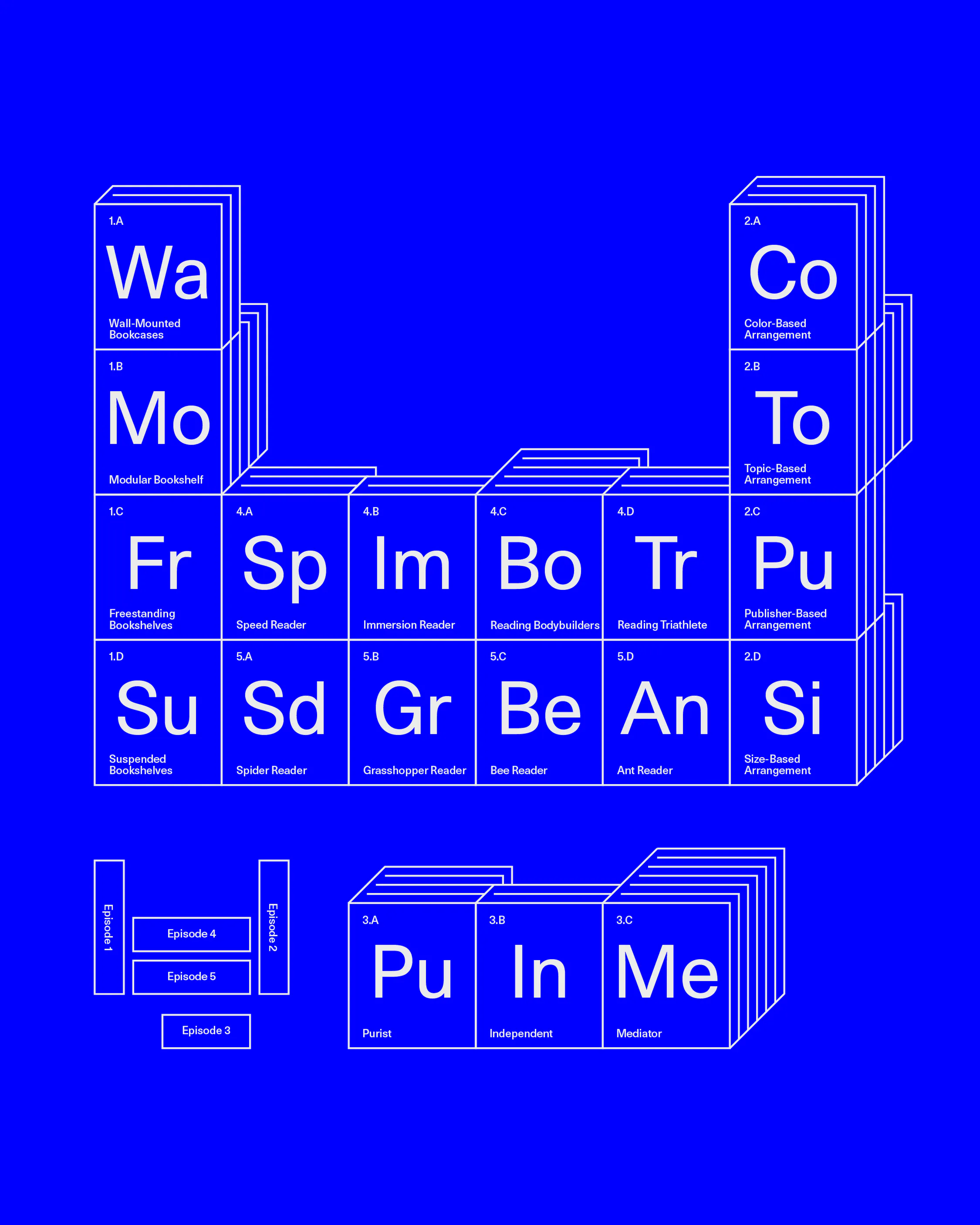
The Periodic Table of Editorial Chemistry
The main instrument of editorial chemistry is, unsurprisingly, its own periodic table. No need for poetic detours: it’s a straight-up elemental breakdown of the categories we explored in earlier episodes. Each of the nineteen categories gets its corresponding element. For example, the Wall-Mounted Bookcase from our Bookshelf Ethology becomes the element “Wa,” while the Size-Based Arrangement gets the element “Si.” To recap, and for your personal fieldwork, here are the categories we’ve identified so far:
- Wall-Mounted Bookcases, Modular Bookshelf, Freestanding Bookshelves, Suspended Bookshelves;
- Color-Based Arrangement, Topic-Based Arrangement, Publisher-Based Arrangement, Size-Based Arrangement;
- Purist, Independent, Mediator;
- Speed Reader, Immersion Reader, Reading Bodybuilder, Reading Triathlete;
- Spider Reader, Grasshopper Reader, Bee Reader, Ant Reader;
But like its nobler cousin, real chemistry, editorial chemistry can’t resist analyzing how elements combine to form new compounds.
And this is where the practical implications of all those earlier lists emerge. Not all elements mix harmoniously, but the field is expanding, and who knows what combinations the future will deliver?
We’ve selected four out of countless possible compounds that may arise from mixing these elements. Think of this as your starter kit for putting the previous episodes’ categories to full use. Let’s get started.
First Combination: Intramolecular
Our periodic table of editorial chemistry identifies a cluster of readers we’ll call Intramolecular. You’ve met them before. Readers, collectors, and book lovers with common traits: consistency, discipline, and a near-monastic loyalty to their goals and priorities. If you’ve been keeping up with previous chapters, they should already feel familiar. These profiles keep emerging, which is exactly why we’re starting with them. These are the people who, unsurprisingly, swear by wall-mounted bookcases, the kind that are neatly divided, immovable, and architecturally sincere. Just like them. Their shelves don’t simply hold books; they anchor the structural integrity of their entire personality. Their aesthetic of choice? Color-Based Arrangement. Step into one of their rooms and you’ll be greeted by sweeping monochromatic fields, entire walls pulsing with gradations of whites, beiges, or midnight blues. If you’re picturing a towering expanse of perfectly aligned white spines, you may have just walked into one of their studies. And the aesthetic decisions don’t end at shelving — they spill over into their reading habits. These readers are textbook Purists. Their books are sacred objects. No travel photographs interrupting the sequence of spines, no books out of place, and no chaotic piles. Everything follows a logical, inviolable sequence. For them, approaching reading is a devotional act. A vow. It’s serious business (unsurprisingly, many of them are researchers). When they read, they descend fully, almost clinically, into the page, becoming perfect examples of the Immersion Reader. And moving from one text to another? That transition is never casual. It obeys a rigorously charted internal research protocol. They function as quintessential Spider Readers: every book, paper, article, or magazine is placed with precision within the expanding web-work they’re constructing, one connection at a time.
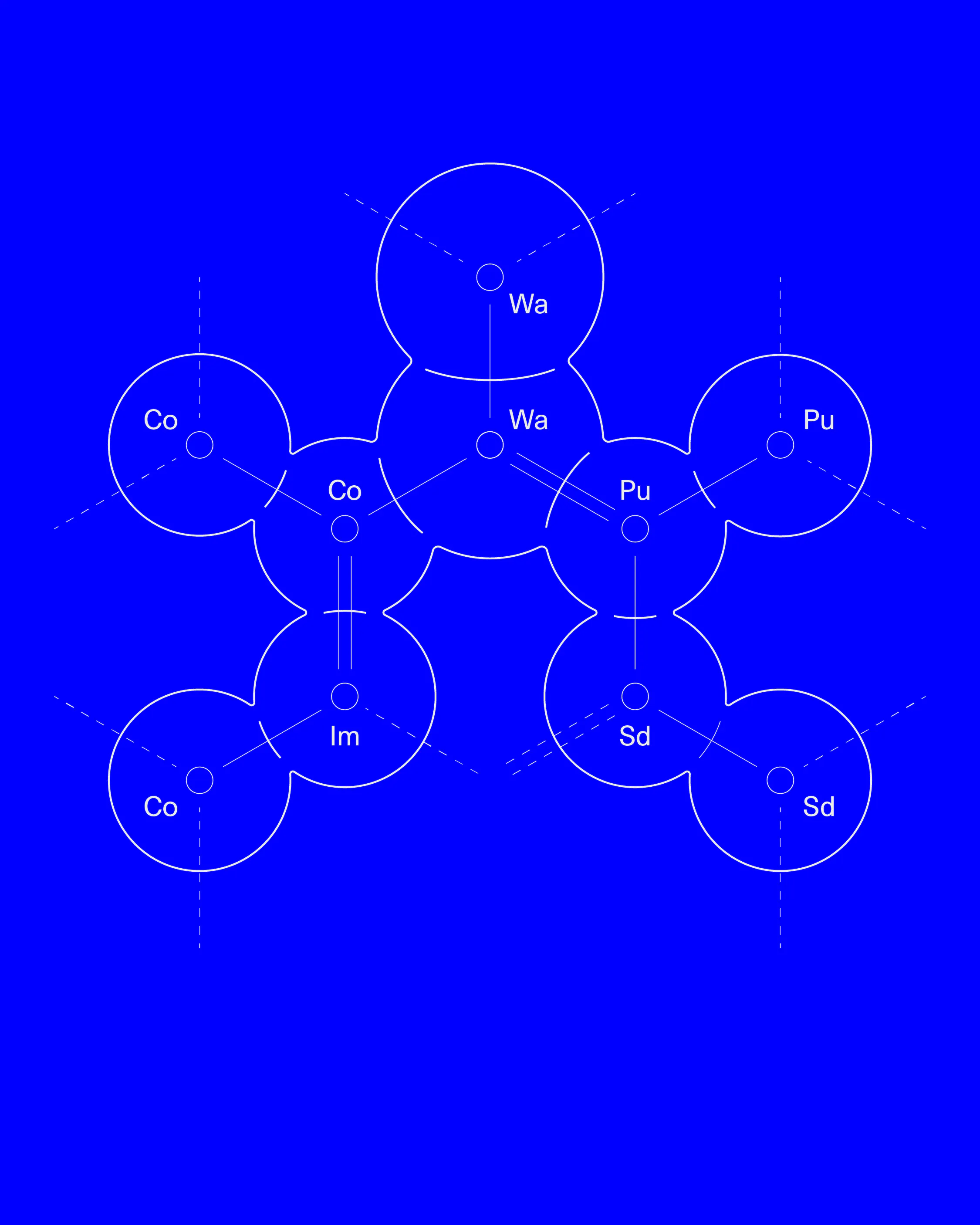
Gas-Purist Reader (Wa₂Co₂Im₂Sd₂Pu₂).
Second Combination: Intermolecular
A second example — sitting at the opposite end of the spectrum from the previous one — is that of Intermolecular bonds: editorial-chemical connections bringing together elements that are looser, more flexible, and, in a sense, more willing to embrace disorder. Readers who fall into this category tend to be devoted admirers of Suspended Bookshelves. The bookshelf, like a climbing plant, spreads through different parts of the home, giving the impression that there’s always room for one more floating shelf to expand an ever-growing book collection. This kind of reader is a committed fan of Topic-Based Arrangement. If you stare for a moment too long at their seemingly random choices — pairing books of different formats, colors, or publishers — they’ll launch into a long, usually unsolicited explanation of what ties them all together. It hardly matters whether that common thread is the name of a person that appears coincidentally across authors, or the fact that each book is set in the American desert. For this reader, the link is obvious and crucial. Their shelves are interspersed with materials of every kind, living and non-living. A fern might serve as the perfect organic divider between one topic and another, a stack of vinyl records might peek out to signal the territory dedicated to sound studies. Yes, you’re looking at a true Independent. Their eclectic method of sorting their editorial goods produces a reading pattern that hops from one subject to another, like a grasshopper. In fact, they’re just what we call a Grasshopper Reader. And of course, they’re also a Speed Reader: the pace at which they classify books on their shelves only matches the speed at which they read them.
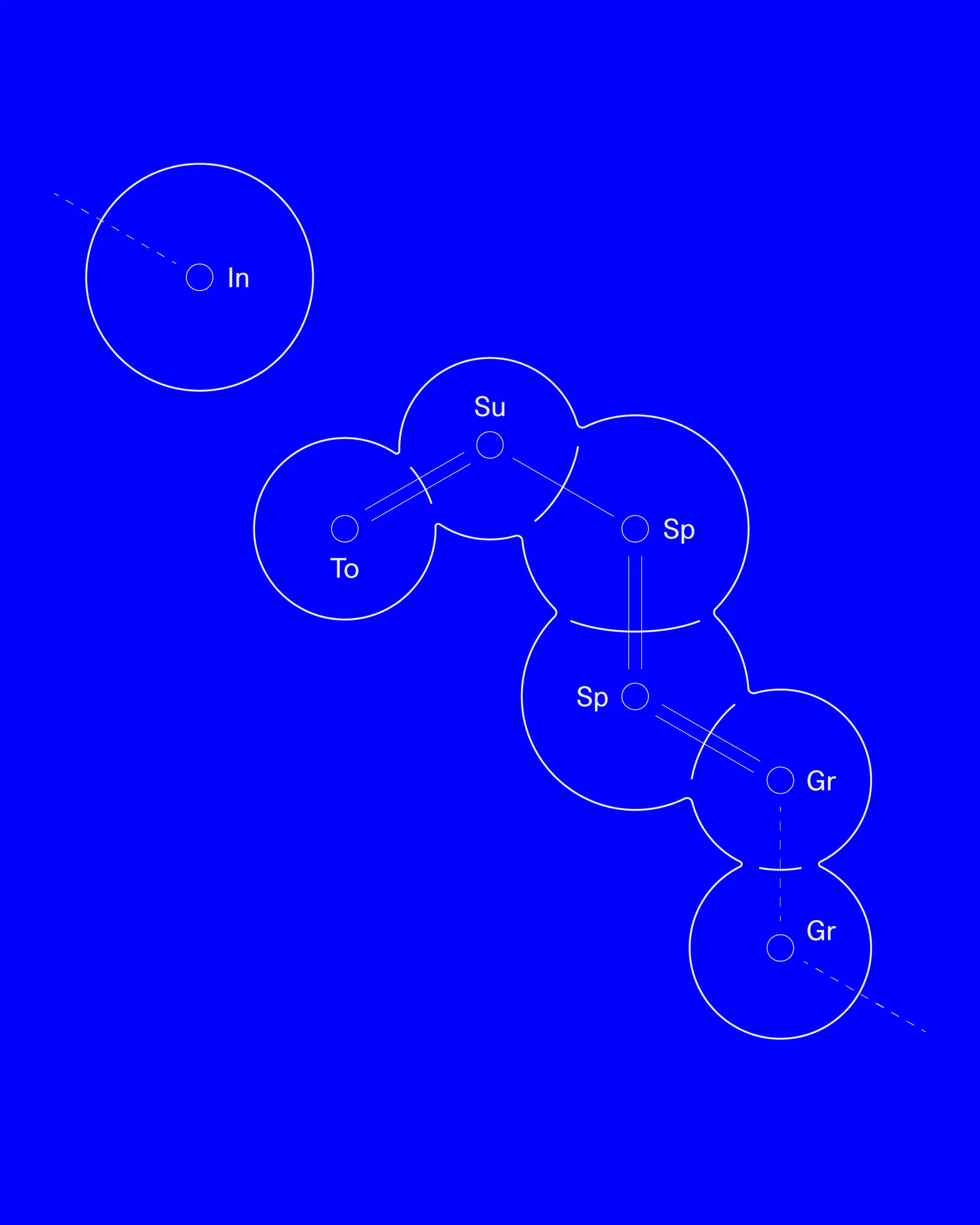
Superoxide-Independent Reader (In-Sp₂Gr₂ToSu).
Third Combination: Balanced Polarity
Editorial chemistry often deals with phenomena that, to newcomers, may seem almost magical, though in reality, they’re far more common than they appear. One such case is the ability of certain compounds, made of both intra — and intermolecular elements, to create a kind of internal stability. By this, we mean compounds that display the steadiness typical of the first type of combination but are built from heterogeneous, flexible components like the second. A reader who fits this combination is typically a modular-bookshelf expert. They appreciate them for their visual versatility and for a touch of the sobriety of wall-mounted bookcases, even without fully identifying with them. As in the second example, these readers also organize their editorial objects using a Topic-Based Arrangement. But unlike the former type, their choices are driven less by personal eclecticism and more by a need for clarity and order. After all, it’s much easier to find Vineland in the “novels” section than by looking among Little Brown titles, or among medium-sized white-spined books. Or at least, that’s the calm explanation this reader will offer you, alongside their habit of creating small pockets of order on each shelf. What they seek, true to their nature as Mediators, is balance and harmony. Whether that harmony drifts occasionally into something slightly eccentric or veers into slight repetition depends on how deeply they inhabit this category (do you recall a previous chapter? True, Average, and Wanna-Be might ring a bell). These traits accompany a reading style that alternates between different speeds, just as the shifting clusters of books are arranged across their modular shelves. Sometimes they turn off all notifications and disappear into a single book for months. Other times, the opposite happens, and you’ll see them skipping from one book to another, or even from one paragraph to the next. This Triathlete of reading is the perfect example of constant alternation between rhythms and styles. And if you’re curious to discover what kind of reading animal they are, from an entomological point of view, just prod them with a remark like: “Wow, I didn’t know you were reading Flesh by Szalay, I saw it in a reel recently…” They won’t even let you finish. They’ll interrupt to tell you that yes, Flesh won this year’s Booker Prize, and yes, everyone is reading it right now, but they were already on it before the hype, emerging fully as Ant Readers. Because, as the reader’s entomology puts it: “They’re tuned into the ecosystem around them. They know exactly where to dig, what to carry, and, most importantly, why it matters.”
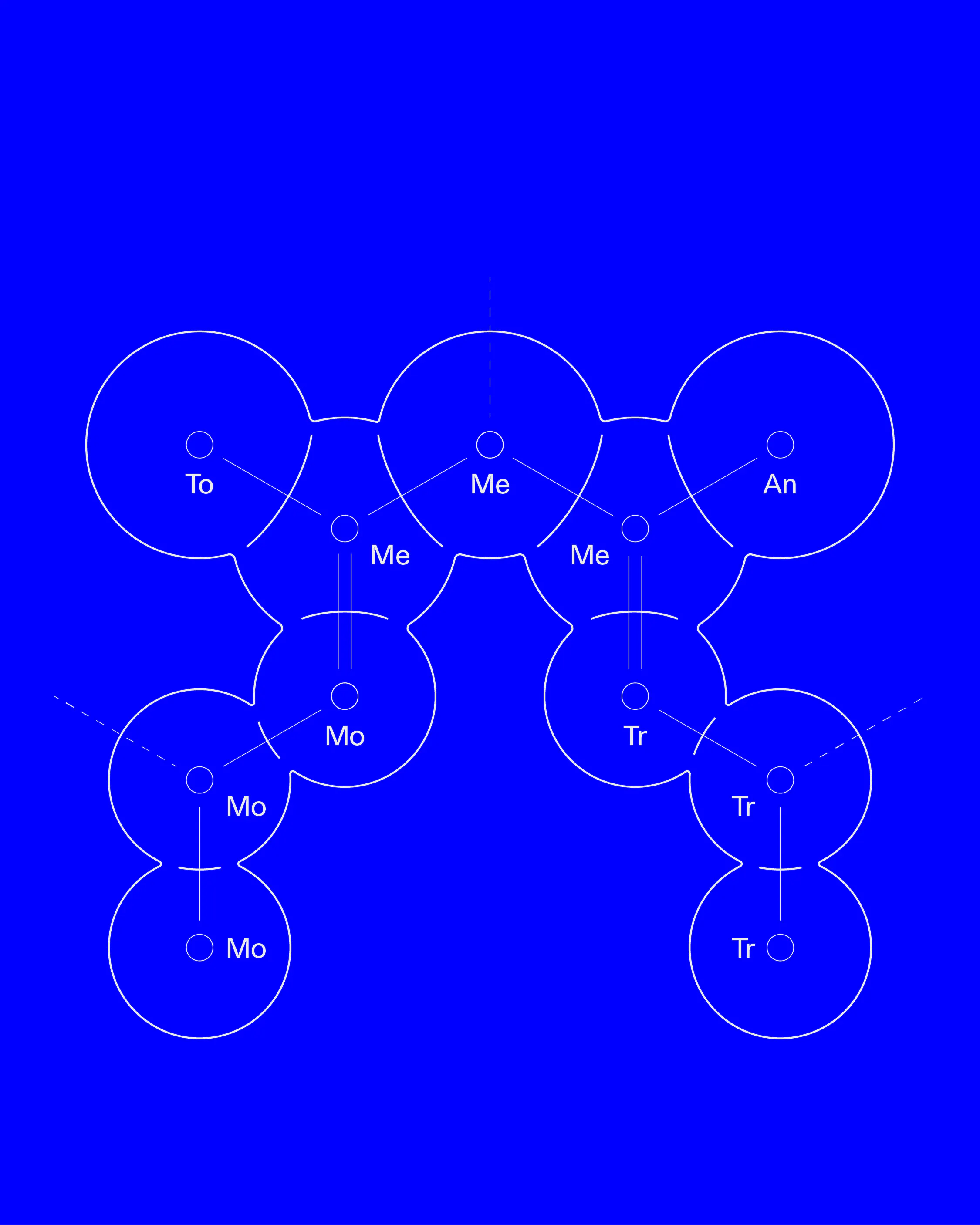
Tri-Atomic Mediator Reader (Me₃Mo₃Tr₃AnTo).
Fourth Combination: The Chaotically Ordinary
If the first three combinations we’ve outlined seem almost disarmingly easy to describe — a dutiful reader, an editorial creative, and a hybrid creature between the two — the reality of everyday reading life is considerably less orderly. In fact, what one encounters most frequently might be described, in the quiet jargon of those who dabble in editorial chemistry, as the Chaotically Ordinary, combinations that look contradictory on paper but which, in practice, are far more routine than we might like to admit: readers whose habits and preferences pull enthusiastically from opposite ends of every spectrum. To the side, you’ll find three examples of compounds that bring together heterogeneous elements. Consider one, among many. Imagine a reader with a deep affection for Wall-Mounted Bookcases. Perhaps it’s nostalgia, the simple appeal of those uninterrupted lines of wood and spine, the kind of architectural order that once defined their childhood home. So far, so tidy. Now imagine that this same reader, like the more taxonomic types we’ve discussed, insists on organizing their collection by topic. And yet, here the picture sharpens; they demand the curatorial perfection of a Purist. Nothing must disrupt the thematic flow as it drifts from one shelf to the next: novels sliding gracefully into anthropology texts, anthropology into graphic novels, and so on. The effect is less an archive than a continuous, whispering gradient of thought. This isn’t unusual. But then introduces a final, destabilizing trait: a reading style reminiscent of the Grasshopper Reader. A mind that leaps, compulsively, from book to book, that collects, abandons, returns, that reads with the fervor of someone seized, intermittently, by a kind of literary possession. On the surface, this restless temperament seems wholly mismatched with a wall-spanning, rigorously curated library. And yet readers of this sort are far more common than we imagine. Ask anyone who studies such things, and they’ll tell you: the most revealing cases live precisely outside the neat boundaries we try to impose. This is where chemistry becomes interesting.
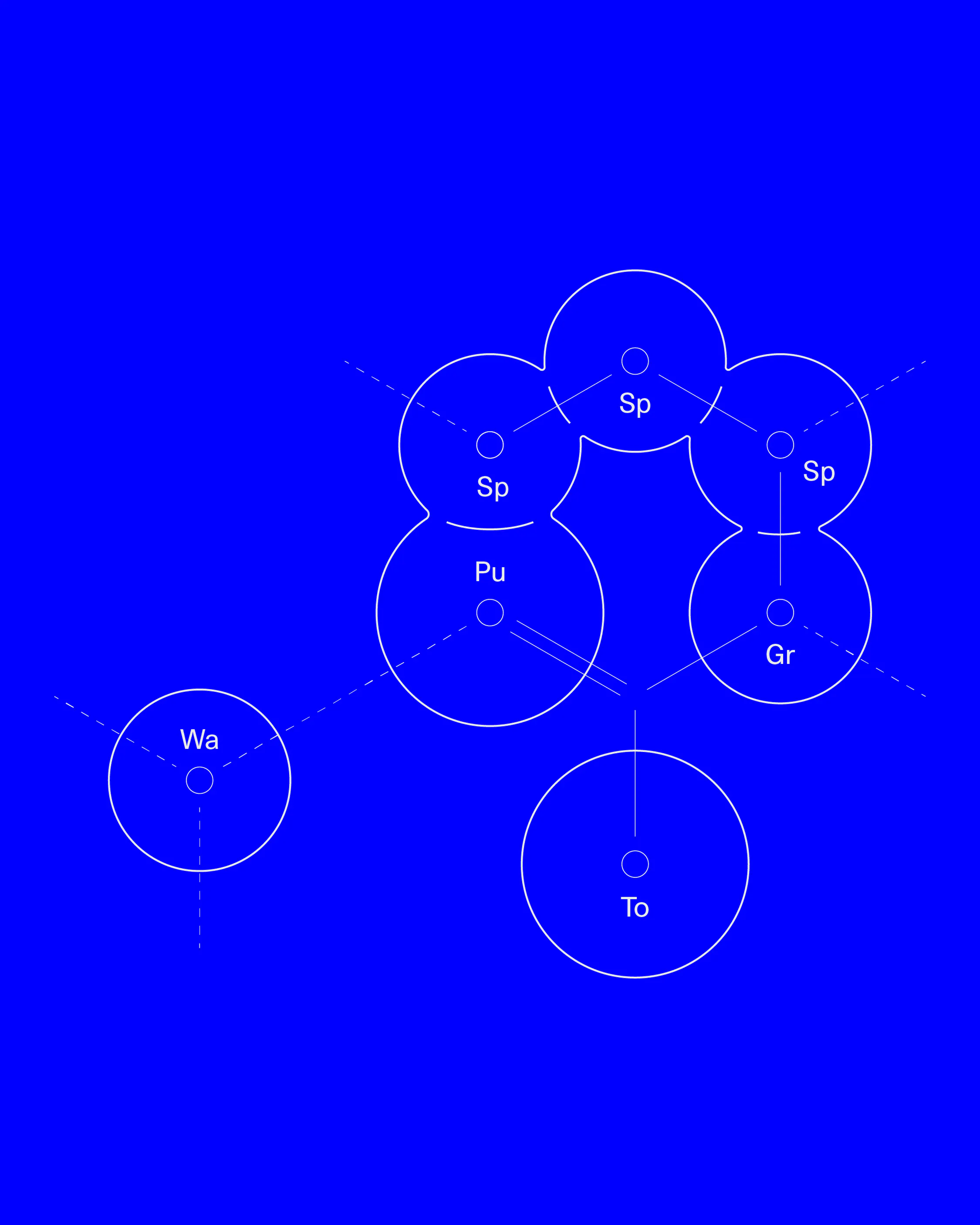
Nitro-Grasshopper Reader (Sp₃GrPuToWa)
Solve et Coagula
One of the guiding principles of alchemy, long before chemistry slipped into its modern lab coat, was solve et coagula: dissolve, then reconstitute. Break apart what exists into its simplest elements, and from those fragments create something new. Editorial chemistry, for all its efforts across the centuries to distance itself from its predecessors, still finds itself haunted, in a productive way, by this impulse. The most curious scholars continue to work under its quiet influence. Throughout these essays, we’ve borrowed from various scientific disciplines to propose a set of parameters for understanding what, why, and how we read, drafting tentative reader profiles along the way. But these categories are only sketches. Early lines. Marks on a map whose terrain has yet to be fully drawn. At the center of this map lie new territories: new ways of reading, new encounters with books, new relationships with the infrastructures of publishing. This is ultimately why we conclude with the chemistry of elements. Every combination is plausible. Every combination leads to a different way of engaging with the editorial world. Solve et coagula is not an attempt to set new definitions. It is, instead, an invitation: to return to the principles first outlined in Against Coffee Table Books and rebuild the small sciences we have proposed here. Dissolve what exists — our inherited methods, our comfortable classifications — so that they may coalesce into new formulas, new structures, and new, as yet unnamed, possibilities for exploring the universe of reading. And to everyone who has traveled alongside these pages, a heartfelt thank you for accompanying our exploration through the uncharted territories of reading. 🐻
bruno. is the pseudonym of Andrea Codolo and Giacomo Covacich since 2013. The project, which is based in Venice, combines a graphic design studio, an exhibition space and a specialist bookstore focussing on visual communication and international independent publishers. As for communication design, the studio deals in particular with visual identities, setting up exhibitions, publishing projects, information design and data visualisation in collaboration with institutions, cultural foundations and private clients. Since 2014 bruno has also become a publishing brand.
bruno. is the pseudonym of Andrea Codolo and Giacomo Covacich since 2013. The project, which is based in Venice, combines a graphic design studio, an exhibition space and a specialist bookstore focussing on visual communication and international independent publishers. As for communication design, the studio deals in particular with visual identities, setting up exhibitions, publishing projects, information design and data visualisation in collaboration with institutions, cultural foundations and private clients. Since 2014 bruno has also become a publishing brand.